
For many collecting institutions, understanding what they hold is shaped by years or decades of growth, changing staff and volunteers, and evolving recordkeeping practices. Important materials may be well cared for but documented in different ways, at different moments in time. Information can live in older inventories, accession files, legacy databases, or informal notes, and some parts of the collection may not be documented at all. As a result, staff and volunteers may not have a clear, current picture of what is in their collections or where everything is located.
This is where a basic inventory comes in, offering a practical way to bring clarity and shared understanding to collections information that has developed over time.
A basic inventory is one of the most effective—and achievable—preservation actions an institution can take. It does not require specialized software, advanced cataloging expertise, or large blocks of uninterrupted time. It does not demand perfection. What it does provide is clarity, confidence, and a foundation for responsible stewardship.
What “basic” really means
When people hear the word inventory, they often imagine a detailed, item-by-item accounting of every object or document in the collection. That kind of work has an important place, but it is not where most institutions need to begin.
A basic inventory is intentionally high-level. In archival and other paper-based collections, materials are typically managed in groupings rather than at the individual item level. A basic inventory reflects this approach by looking at the collection as a whole and organizing materials in manageable groups.
Information is recorded at the box, drawer, or shelf level, creating a practical, working document that supports day-to-day use by staff and volunteers. The goal is not exhaustive detail, but a shared understanding of what is held and where it can be found.
Equally important is what a basic inventory is not. It is not full processing. It is not a public finding aid. It is not a final or permanent document. It does not require every question to be answered or every mystery to be solved.
A basic inventory allows room for uncertainty. It can include notes such as “unknown,” “approximate,” or “needs review,” and it is designed to be updated and refined over time. Starting imperfectly is not a failure; it is often the most realistic and responsible approach.
Inventory is preservation
Preservation is often associated with tangible actions: rehousing materials, improving storage furniture, stabilizing temperature and humidity, or addressing damage. All of those efforts matter. But none of them can be prioritized effectively without knowing what you have and where it is.
A basic inventory supports preservation in several important ways:
- Reduces unnecessary handling: When materials are easier to locate, staff and volunteers spend less time opening boxes, shifting piles, or searching through drawers.
- Reveals risk: Overcrowded shelving, damaged enclosures, mixed formats, and fragile materials often become visible for the first time during inventory work.
- Supports emergency response: In a disaster or emergency, knowing what collections exist and where they are located can make the difference between being able to act quickly and losing collections before they can be stabilized or salvaged.
- Informs decision-making: Inventory data helps institutions identify priorities for rehousing, conservation, or environmental improvements.
Many preservation challenges are not caused by poor intentions or neglect; they stem from a lack of visibility. A basic inventory brings collections out of the abstract and into focus.
Inventory builds confidence, not just records
One of the most overlooked benefits of a basic inventory is how it changes the way people work with collections. Many institutions rely heavily on institutional memory—on what long-time staff or volunteers “just know.” While that knowledge is valuable, it is also fragile. Staff retire, volunteers step away, and new people join. Without shared documentation, collections knowledge can disappear quietly and quickly.
A basic inventory helps institutions maintain continuity over time by providing a clearer framework for working with collections. As people and roles change, a documented record of what is held and where materials are located offers a stable reference point. This clarity supports consistent handling and decision-making and helps routine collections work, from retrieval to rehousing, proceed more predictably and efficiently.
Having an inventory does not mean every question has been answered. It means fewer decisions are made in the dark. That shift from guessing to knowing builds confidence across an organization.
Planning, funding, and advocacy become easier
Inventory work also strengthens an institution’s ability to plan realistically and advocate effectively. When institutions can clearly describe how much material they hold, what formats are represented, where materials are stored, and what condition issues exist, they are better positioned to plan responsibly. This information supports realistic estimates of supply and staffing needs, helps explain priorities to boards and administrators, strengthens grant proposals, and provides a clear basis for justifying investments in collections care.
A basic inventory turns general concerns into documented needs. It helps institutions move from “we think this is an issue” to “we know this requires attention.”
Starting small is the strategy
One of the reasons inventory work is delayed is the belief that it must be comprehensive to be worthwhile. In reality, many successful inventory projects begin with a very limited scope: one room, one storage area, one cabinet, or one day a week.
Progress does not require doing everything at once. A partial inventory can still be useful, and a working document can still provide real value. What matters most is momentum, not completeness. A basic inventory is not an end point but a starting place: it creates a clearer picture of the collection as it exists today and provides a framework that can grow and improve over time.
One achievable step forward
Every collecting institution, regardless of size, staffing, or resources, can benefit from a basic inventory. It is one of the most accessible tools available for strengthening stewardship, reducing risk, and building confidence in collections care.
You do not need perfect information. You do not need specialized systems. You do not need to solve everything at once. You only need to begin where you are, with the collections you have.
If you needed to locate something in your collection tomorrow, could you do it easily? A basic inventory helps make that answer “yes.”
Ready to take the next step?
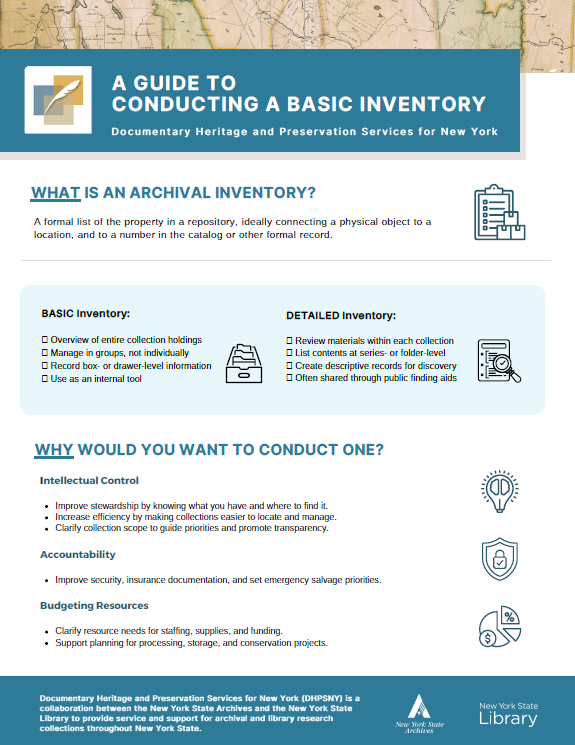
If you are thinking, This sounds important, but how would we actually do this? DHPSNY’s technical bulletin, A Guide to Conducting a Basic Inventory, offers practical guidance for planning and carrying out an inventory project at a scale that makes sense for your institution. It is designed to be flexible, realistic, and adaptable to different collection types, staffing models, and levels of experience. This technical bulletin is also available in Spanish.
Do you have a preservation topic, question, or creative solution you would like us to cover in this series? Reach us by email at info@DHPSNY.org, or connect with us on the DHPSNY Facebook page or DHPSNY Community Facebook Group.