
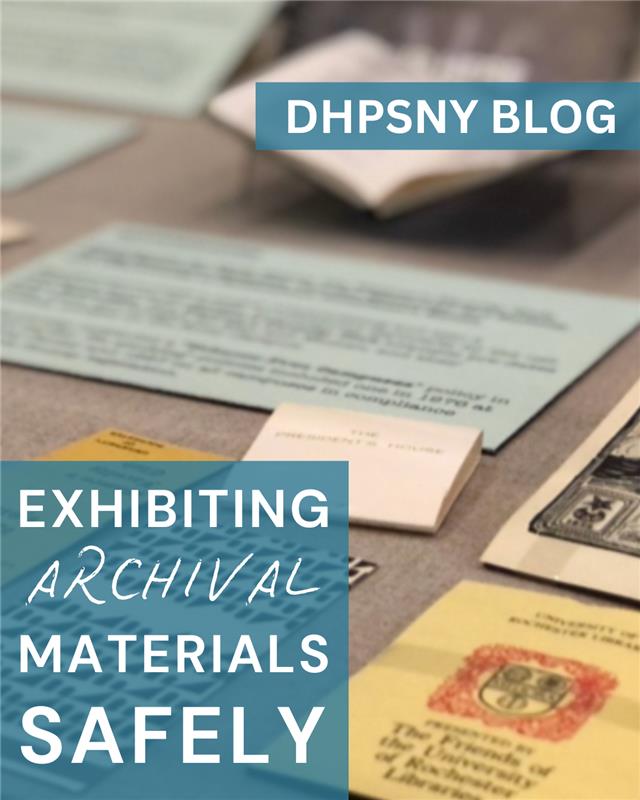
Exhibits are one of the most effective ways cultural heritage organizations connect with their communities. They bring collections out of storage, tell stories, and make history visible and meaningful. At the same time, they introduce archival materials to a range of environmental risks that must be carefully managed.
In site visits across New York State, DHPSNY staff regularly see thoughtful, engaging exhibits created with care and enthusiasm. Just as often, we see the challenges that come with exhibiting archival materials, particularly when objects are exposed to light for extended periods, supported with unstable materials, or displayed in spaces with difficult-to-control environmental conditions. The question is not whether to exhibit collections, but how to do so in a way that balances public access with long-term preservation.
The Challenge: Access and Preservation
Every exhibit involves a series of decisions: what to display, how long to display it, and under what conditions. These decisions are often shaped by staff capacity, available space, and institutional priorities, as well as the desire to share meaningful stories with the public. With each of these choices, there is a balance to consider. Exhibits are designed to increase visibility and engagement, but the very act of display introduces risks (light exposure, handling, environmental fluctuations) that can contribute to long-term damage.
For many organizations, especially those with limited staff or resources, this balance can feel difficult to achieve. In practice, it often comes down to a series of small, intentional adjustments to planning, materials, and procedures that can significantly reduce risk.
Common Challenges in Exhibits
A few common issues tend to arise when archival materials are put on display, particularly when time, space, or resources are limited. Recognizing these challenges early can help organizations plan more effectively and avoid preventable damage.
One of the most frequent challenges is a lack of advance planning. Exhibits are often developed on tight timelines, especially when tied to events, anniversaries, or seasonal programming. Without a clear framework in place, decisions about object selection, display methods, and environmental conditions may be made quickly, without fully considering long-term impacts. In many cases, organizations do not yet have a formal exhibition policy, which can lead to inconsistencies over time.
Light exposure is another persistent concern. Damage caused by light is cumulative and irreversible, particularly for paper-based materials and photographs. When items remain on display for extended periods without rotation, even moderate light levels can lead to fading, discoloration, and weakening of materials.
The materials used in exhibits can also cause inadvertent damage if they are not carefully selected. Adhesives, foams, fabrics, and certain plastics may off-gas or contain acids that can harm collections over time. Similarly, mounts that are not properly designed or fitted can place stress on fragile objects or fail to provide adequate support.
Environmental conditions in exhibit spaces often differ from those in storage areas and are typically less stable. Temperature and relative humidity may fluctuate more widely, especially in historic buildings or multi-use spaces. These changes can accelerate deterioration and contribute to physical stress in materials.
Finally, the processes of installing and removing exhibits are themselves high-risk moments. Increased handling, movement, and setup activities create opportunities for accidental damage, particularly if staff or volunteers are working without clear handling procedures or appropriate supports.
Practical Strategies for Safer Exhibits
The goal of preservation in exhibits is not to eliminate all risk, but to reduce it in thoughtful, manageable ways. A few core strategies can make a significant difference and are realistic for most organizations to implement.
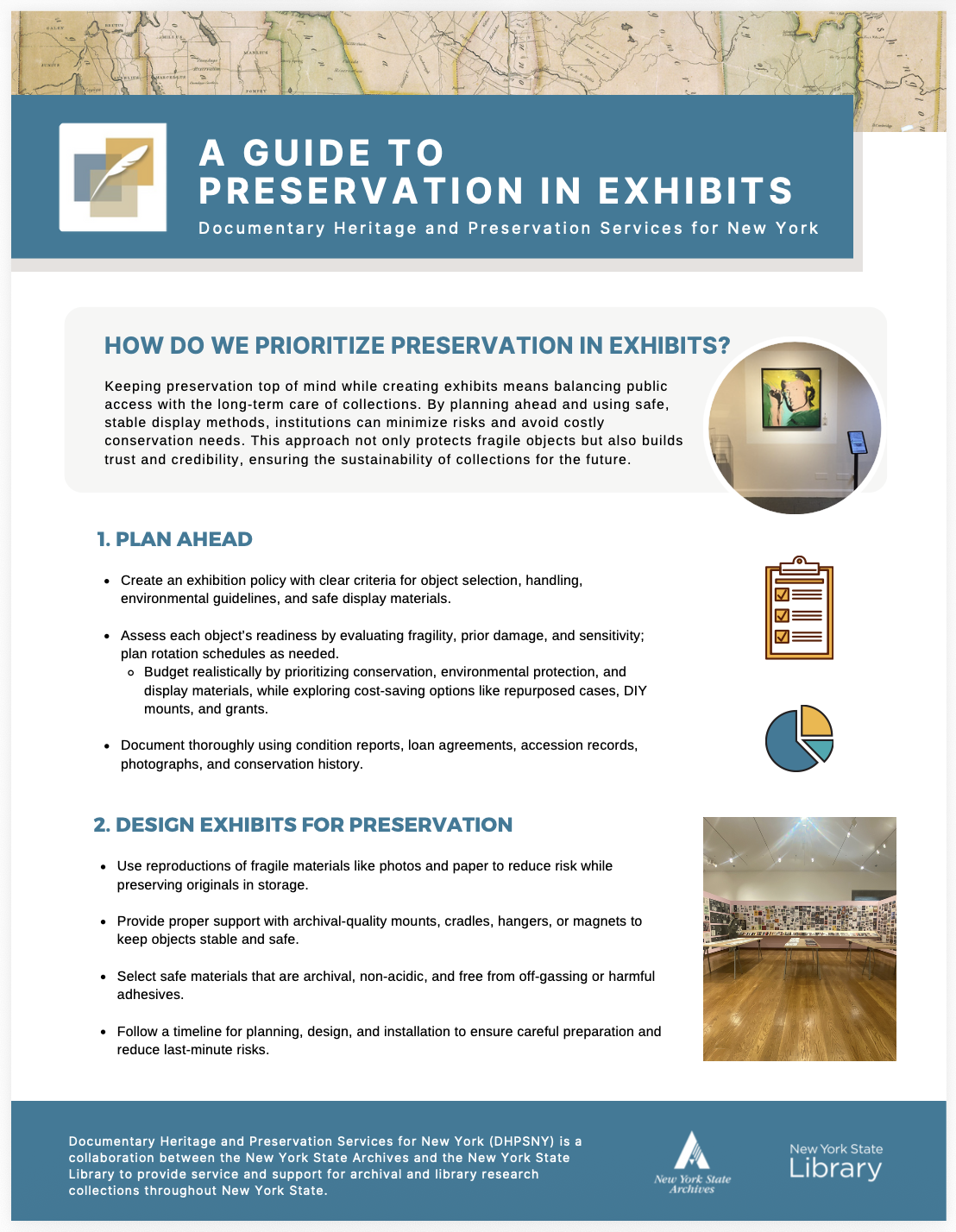
- Planning ahead is one of the most effective steps an organization can take. Even a simple exhibition policy can provide valuable guidance by establishing criteria for object selection, handling practices, environmental expectations, and approved display materials. Planning also creates an opportunity to assess each object’s condition and determine whether it is suitable for display or if a reproduction would be a better option.
- Budgeting is part of this process as well. Allocating resources toward safe materials, proper supports, and basic environmental improvements can prevent more significant conservation issues later. While budgets are often limited, prioritizing these elements early in the process helps avoid last-minute compromises that increase risk.
- Documentation is another essential component. It is important to record when and where an object has been exhibited, as exhibition history should be part of its overall record. This information can help track how often materials are on display and inform future decisions about rotation and use. Condition reporting provides a baseline for comparison before and after exhibition. This can be as simple as noting visible damage or areas of weakness and photographing the object in its current state. This step is often overlooked but becomes especially important when evaluating whether display conditions may have caused changes over time. For guidance on condition reporting, see Revisiting Basic Condition Reporting: Updated Insights and Digital Methods, a Connecting to Collections Care webinar.
- Exhibit design also plays a critical role in preservation. Whenever possible, reproductions can be used for particularly fragile materials, allowing organizations to share content while minimizing risk to originals. When original materials are displayed, proper support is essential. Archival-quality mounts, cradles, and supports help keep objects stable and reduce physical stress, particularly for bound volumes, oversize paper, or objects with existing damage.
It is also worth emphasizing that safe exhibits do not have to be expensive. Many organizations successfully create custom mounts using basic materials such as Ethafoam, Mylar, or museum board. Affordable display supports include jewelry stands, acrylic risers, easels, shadowboxes, or sports memorabilia cases. Existing exhibit cases can often be improved with simple modifications, such as adding UV-filtering film or muslin linings. The key is to ensure that all materials in contact with collection items are stable and appropriate for long-term use. The same guidelines that apply to collection housing materials also apply in exhibition contexts. For more information, see DHPSNY’s blog post, DHPS Tips: What Does “Archival Quality” Really Mean?
In day-to-day exhibit management, a few core practices go a long way. Limiting light exposure through the use of LED lighting, UV filters, and rotation schedules helps reduce cumulative damage. Maintaining stable temperature and relative humidity supports the long-term stability of materials, even if ideal conditions are not always achievable in exhibit spaces. Reducing exposure to pollutants, handling objects carefully with appropriate support, and ensuring that exhibit areas are secure all contribute to a safer display environment.
After the Exhibit
Preservation does not end when an exhibit is taken down. The period immediately following deinstallation is an important opportunity to assess the impact of display. Objects should be carefully returned to appropriate storage and evaluated for any changes in condition, including subtle shifts such as fading, distortion, or surface changes. Even minor changes can provide useful information for future exhibit planning. Maintaining rotation schedules for future exhibits can help reduce cumulative exposure over time, particularly for light-sensitive materials. Custom mounts created for an exhibit can often be reused, saving both time and resources.
Just as importantly, taking time to reflect on what worked well and what could be improved can help strengthen exhibit planning and preservation practices going forward. This kind of evaluation does not need to be formal to be effective; even a brief internal discussion can help identify small adjustments that will make future exhibits safer.
Small Changes, Lasting Impact
Even small changes such as shorter display periods, more supportive mounts, or selecting safer materials can have a meaningful impact on the long-term preservation of collections.
By keeping preservation at the forefront of exhibit planning and design, organizations can continue to share their collections with the public while ensuring they remain accessible for years to come.
For a quick reference guide to the concepts discussed in this post, download DHPSNY’s technical bulletin: A Guide to Preservation in Exhibits in English and Spanish. For a more in-depth look at implementing these changes, watch the full DHPSNY webinar: Preservation in Exhibits.
Do you have a preservation topic, question, or creative solution you would like us to cover in this series? Reach us by email at info@DHPSNY.org, or connect with us on the DHPSNY Facebook page or DHPSNY Community Facebook Group.
Image credit: Background photograph courtesy of Rare Books, Special Collections, and Preservation, River Campus Libraries, University of Rochester.